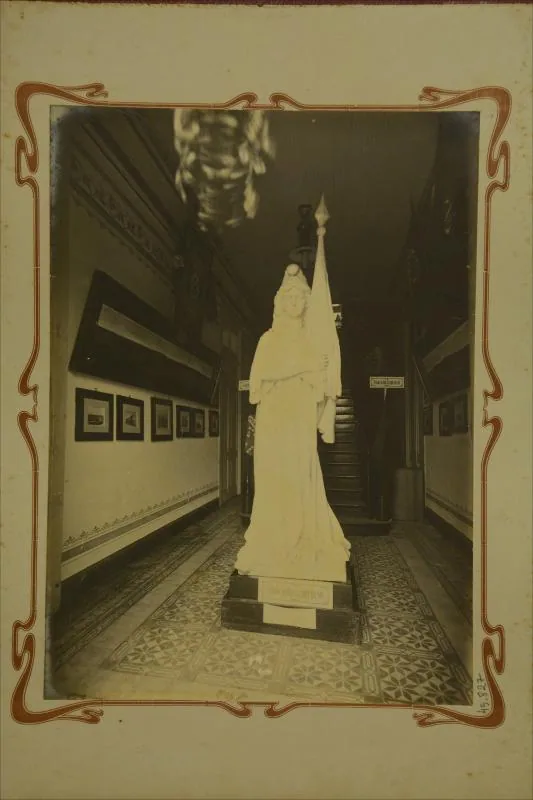
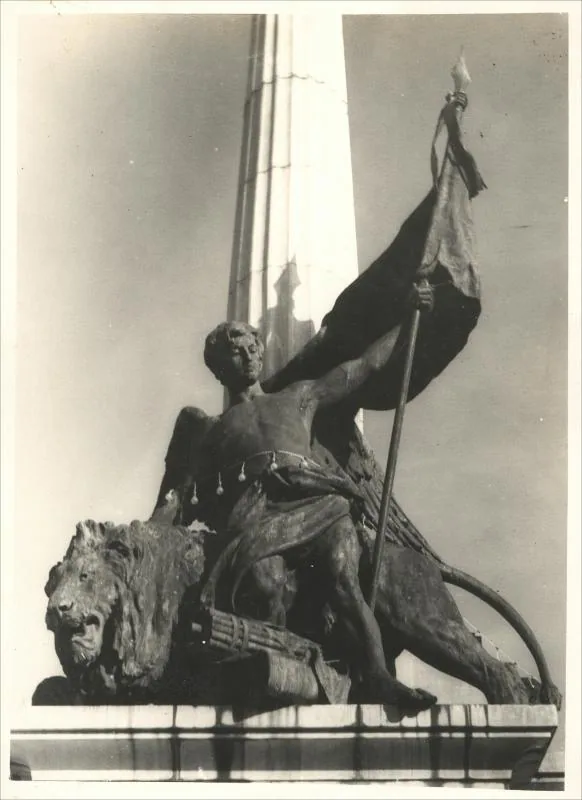
The Paradox of Petrified Sovereignty
Between political Independence in 1822 and the Centenary of 1922, the Brazilian State covered its
palaces, courts, coins, banknotes, and constitutional frontispieces with sovereign female bodies:
the Positivist Republic, Justice in white robes, the Nation, Liberty. Yet under the very laws
sanctioned beneath these effigies, living women remained subject to relative civil incapacity
(the marital guardianship codified in the 1916 Civil Code) and strict political exclusion
(disenfranchised until 1932).
Developed by Ana Vanzin ↗
at the Graduate Program in Law of the Federal University of Santa Catarina (PPGD/UFSC), the doctoral
dissertation Mármore à Margem: Female Allegories and Legal Legitimacy in Brazil (1822–1922)
constitutes the inaugural, bounded research strand within the broader transnational comparative atlas
Mnemosyne Viva. While the atlas gathers 337 cataloged items across 17 countries, this
strand isolates 53 Brazilian works produced between 1822 and 1922, examining them in
tension with both their Atlantic matrices and their post-1922 forensic afterlives.
In marmore regnat, in iure tacet: In marble she reigns, in law she is silent. The female body is
elevated to the eternal facade of legal legitimacy at the exact measure in which living women are
placed at the margin of civil capacity and citizenship.
Pillar I · Neoclassical Petrification & the Visual Racial Contract
Through the formal mechanism of Classical Purification (Matrix errans, lex immobilis), the state extracts historical contingencies, corporeal marks, and racial plurality in favor of a standardized, white, Greco-Roman canon imported via European academic missions and numismatic matrices. Even when early imperial iconography summoned the romantic indigenist body, its posture and drapery were progressively disciplined by European neoclassical grammar.
Pillar II · Civil Incapacity & State Femininity
Under the Visual Sexual Contract (Imago imperat, femina excluditur) and State Femininity (Dea in foro, mulier sub tutela), the proliferation of female allegories in public forums, currency, and constitutional prints operated as an epistemic screen: the symbolic omnipresence of the Sovereign Woman naturalized the legal silence of women under marital guardianship and civic exclusion.
Three Historical Acts (1822–1922)
Rather than a linear evolution, the century between Independence and the Centenary unfolds across
three historical-juridical acts in which distinct allegorical repertoires coexist, clash, and sediment.
Act I (1822–1889: Empire, Indigenist Body, and Neoclassical Acclimatization · Império, corpo indigenista e aclimatação neoclássica)
From the Constitutional Empire of 1822–1824 through the Second Reign, the newly independent monarchy sought an autonomous visual vocabulary while relying on European academic conventions. Allegories of America and the Empire alternated between feathered indigenist personifications and draped neoclassical figures of Justice, Commerce, and Liberty on imperial medals, bonds, Treasury banknotes, and architectural reliefs, staging a territory represented as available nature governed by a patriarchal and slaveholding legal order.
Act II (1889–1891: The Proclamation, Positivism, and the Republic in Effigy · A Proclamação, o positivismo e a República em efígie)
With the Proclamation of the Republic in 1889 and the Constituent Assembly of 1890–1891, the removal of Emperor Pedro II's portrait required an immediate visual surrogate on coins, stamps, and public buildings. Disputed between Jacobin republicans (who invoked the insurgent French Marianne) and Orthodox Positivists (who modeled Motherland and Humanity after Auguste Comte's Clotilde de Vaux, crowning her with the Phrygian cap as Décio Villares did in c. 1900), the female effigy became the official face of the new regime at the exact moment the 1891 Constitution excluded women from suffrage.
Act III (1916–1922: The 1916 Civil Code, Marital Tutela of Married Women, and the Independence Centenary · O Código Civil de 1916, a tutela da mulher casada e o Centenário da Independência)
The culminating paradox of the period crystallizes between the promulgation of the 1916 Civil Code (Law No. 3,071/1916, Article 6, II, which classified married women as relatively incapable alongside prodigals and minors) and the monumental celebrations of the 1922 Independence Centenary. While bureaucratic currency (In nummis domina, in legibus ancilla) and civic statuary multiplied stabilized, purified female bodies across state capitals and national exhibitions, positive private law codified the legal subordination of wives under marital guardianship (tutela).